
A failed ad isn’t wasted money — it’s a data point about your audience. Capture why it lost, isolate the parts that worked, and recycle them into your next test instead of starting over from scratch.
TLDR — How Do You Turn Failed Ad Creative Into Winners?
- A failed ad isn’t wasted spend — it’s audience data you either capture or trash.
- Creative drives ~half of ad sales lift (Nielsen), so duds are worth mining.
- A dud becomes a loss only when no one documents why it lost.
- Write a one-sentence hypothesis before launch, a result after — then share it.
- Break ads into parts; isolate the hook, since it signals whether anything works.
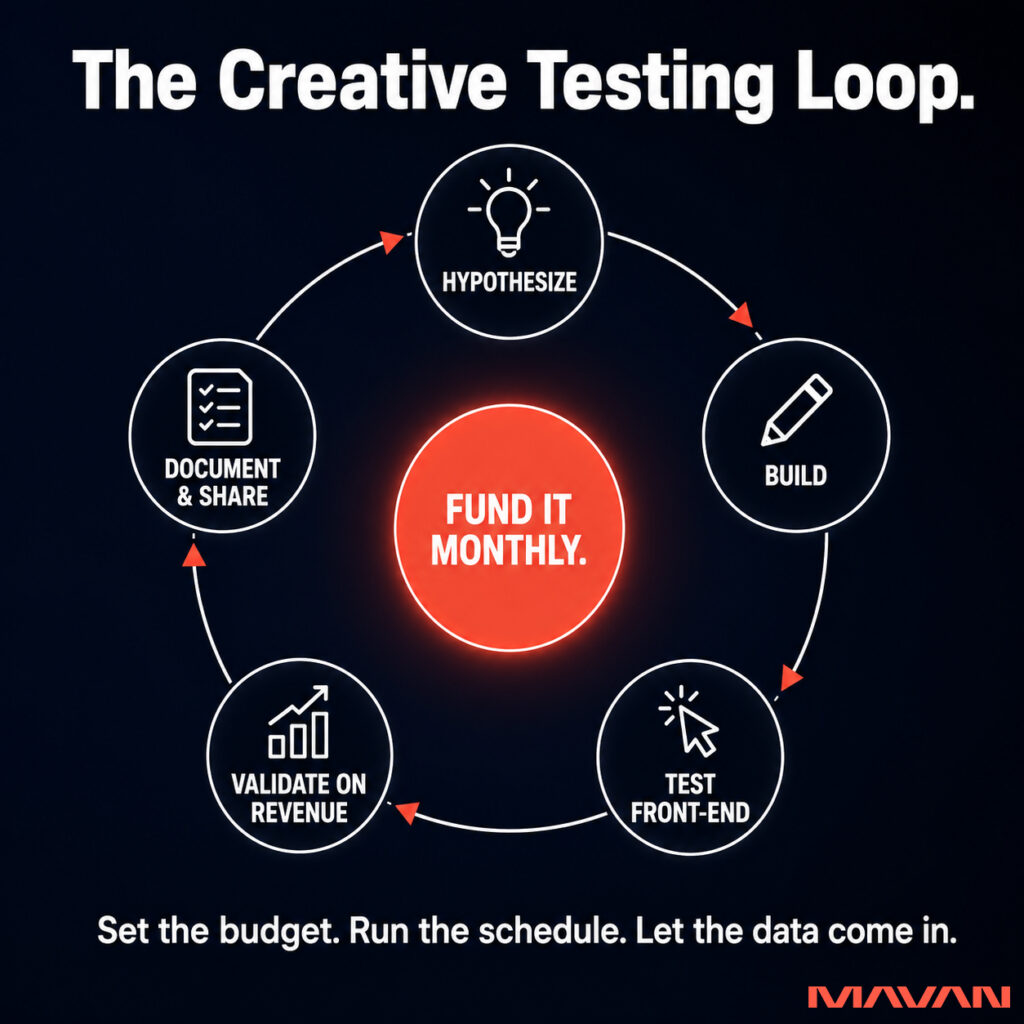
- Run the loop: hypothesize, build, test front-end, validate on revenue, document.
- Fund creative testing with a standing double-digit budget share, monthly.
- Don’t yank the wheel early or tweak daily — let data come in first.
- Fatigue isn’t death: rest winners, rotate a portfolio, retest old losers.
- Want eyes on your whole creative system? Contact MAVAN for a 360 Growth Analysis.
The ad you killed last week probably had a winner hiding inside it. Maybe the hook was sharp and the offer was wrong. Maybe the offer landed and the visual buried it. You paused the whole thing, logged it as a loss, and moved on — and the most useful information you bought all month went straight into the trash.
That trade happens every day inside growth teams running paid acquisition.
This article is for the person who owns the creative number: the Head of Growth, the first marketing leader, the founder still approving every ad at a post-product-market-fit SaaS, consumer, or gaming company.
The promise is simple. By the end, you’ll have a repeatable way to read a dud as signal, pull out the parts worth keeping, and cycle them back into a portfolio that keeps performing — because the difference between a dud and a real loss is almost always your system, not your luck.
Why Does Ad Creative Matter More Than Targeting Now?
Creative is the single biggest lever you can pull on paid performance, which is exactly why a failed ad is worth mining instead of deleting. Nielsen’s research across hundreds of campaigns found creative quality drives close to half of the sales lift advertising produces — and in digital specifically, Meta puts that figure at 56%.
As targeting signals weakened after Apple’s privacy changes and platforms automated most of bidding, the variable still under your control moved to the asset itself. Sam McLellan, VP of Growth at MAVAN, says it plainly: “Creative is by far the biggest lever we can pull. That’s the one we have on pretty much every platform.” When the asset carries that much of the outcome, the cost of a flop is not the few hundred dollars you spent showing it. The cost is the lesson about your audience you fail to extract.
A dud tells you something a winner never will — which hook fell flat or which promise nobody believed. A failed ad is the cheapest audience research you will ever buy, as long as you actually read it.
That reframe matters more in 2026, because budgets are tighter and every test has to earn its keep. Gartner’s 2024 CMO survey put marketing spend at 7.7% of company revenue, down from 9.1% the year before. Doing more with less doesn’t mean testing less. It means wasting less of what each test teaches you.
Creative being the biggest acquisition lever you have is precisely why throwing away the losers is so expensive.
Is a Failed Ad Just Wasted Money?
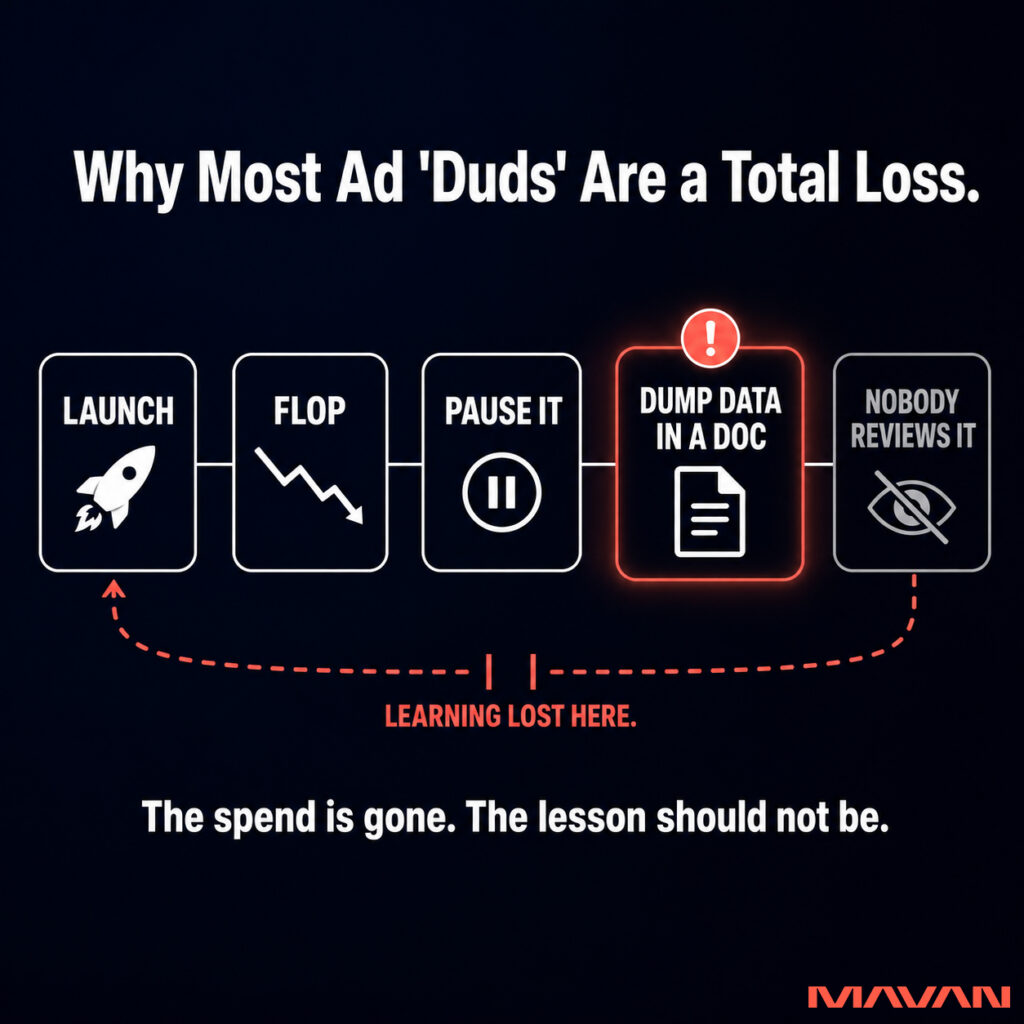
No — a failed ad is only wasted money if you learn nothing from it. The spend is gone either way. The one variable you control is whether the result becomes a documented insight that sharpens your next round, or a number nobody looks at again. A dud you understand is fuel. A dud you ignore is the real loss.
Sam McLellan, VP of Growth at MAVAN, is direct about the price of patience in performance marketing: “Some dollars are wasted, but as long as we’re learning from it, that’s okay.” The waste isn’t the failed creative. The waste is the meeting that never happens. He’s watched the pattern at company after company: the test runs, the results come in, and then the learning evaporates. “No one reviews that data,” he says. “There’s no, ‘Hey, how did those creatives do?’ Why didn’t they work, and what was the test, and what was the hypothesis?” One person dumps the numbers into a spreadsheet, or worse, a forgotten doc, and the team moves on to the next batch having banked none of it. Six months later they relearn the same lesson with fresh budget.
The fix costs almost nothing. Before you launch anything, write the hypothesis down in one sentence. When the results land, write a second sentence on what happened and why. Then say it out loud to the people who make the next creative. That last step is the one teams skip, and it’s the one that compounds. A documented dud narrows the search for your next winner — you’ve eliminated a hook, a format, or an angle, and you’ll never waste money on it again.
How Do You Find What Actually Worked in a Failed Creative?
Stop judging the ad as one finished object and break it into parts. Every creative is a stack of components — the hook, the middle, the close, the visual, the format — and each part wins or loses on its own. Isolate one variable at a time, and a “dud” usually reveals one strong piece worth saving and one weak piece worth cutting.
This is where the old instinct to scrap a flop and start clean costs you the most. The hook is the part to read first, because it’s the leading signal of whether anything else gets a chance. “I look at it more from the perspective of what’s actually initially grabbing people,” says Sam McLellan, VP of Growth at MAVAN. “What’s the solid hook?”
On most platforms, the first frame of a video or the first line of a static decides whether the body and the offer ever get seen — so a low click-through rate often means the hook failed, not the product. Pull the hook off your worst performer and test it on a body that already converts. Take the closing line from a winner and bolt it onto a concept that stalled. Swap the color treatment. Change the format from static to motion. When you build ads as modular pieces instead of monoliths, you can mix and match the strong parts and retire the weak ones. You also get a faster, cheaper test, because you’re changing one thing and reading one result — not guessing which of six differences moved the number.
The discipline of isolating variables is the backbone of any real creative testing framework, and it turns a vague “that one didn’t work” into a precise “that hook didn’t work, but the offer did.” This is also how testing surfaces winners you’d never have greenlit on instinct. In our work with KidStrong, the top-performing creative wasn’t the polished studio concept — it was authentic, parent-filmed reels that the testing loop identified as the real conversion drivers.
What Does a Good Creative Testing Loop Actually Look Like?
A good creative testing loop runs in repeatable phases: form a hypothesis, build the creative, review it internally, test it on front-end metrics, then validate winners on revenue, and finally document and share what you learned. Set a fixed share of budget for it, run it on a schedule, and resist the urge to yank the wheel before the data arrives.
Sam McLellan, VP of Growth at MAVAN, starts the loop with a guess worth testing, not a pretty picture. “I usually start with ideation around a hypothesis,” he says. His example: a soda brand shouldn’t just film someone drinking in the sun because sun sells. The hypothesis is sharper than that — maybe West Coast surf imagery sells the lifestyle. “But if it’s the middle of winter in New York, that’s not going to fly,” he notes. “Nobody wants to be seen surfing right now.” A hypothesis gives the test something to prove or kill. Here’s the loop, written so each step stands on its own:
- Ideate around a hypothesis. Name the specific belief you’re testing — an audience, an angle, a hook — not just “a new ad.”
- Build the initial creative. Use AI to generate volume against the hypothesis, then review it internally before you spend. A concept that sounded good in the brief often falls apart once you see it.
- Test on front-end metrics. Launch and watch the early signals: click-through rate, the hook’s pull, and where the platform chooses to spend.
- Validate on revenue. Take the front-end winners into evergreen campaigns and read the mid- and lower-funnel — is this actually ROAS-positive, or just a cheap click?
- Document and share. Capture the result against the original hypothesis and bring it to the team. This step is the one that compounds.
Two rules keep the loop grounded. First, fund it purposefully. “Set your ground rules early on,” McLellan advises. “What percent of budget are you going to spend on creative testing? And you do it monthly. Don’t half-ass it.” Second, be patient with the read. He compares large-budget acquisition to steering a cruise ship: “We’re in a cruise ship. We can’t go 90 degrees in a moment.”
The two ways teams sabotage themselves sit at opposite ends. One camp waits for 90% statistical confidence, which “takes a long time and a lot of money” to reach when you already knew the direction days earlier. The other camp reacts on gut every morning, tweaking constantly until “you’ve kept that thing in learning phase for so long that the answers aren’t even relevant to the original question anymore.” The win is in the middle — a funded, scheduled loop that lets the data come in before you grab the wheel.
This is the same patience behind our argument that sometimes the smartest test is to turn the spend off entirely and watch what the data tells you.
How Do You Know When a Creative Is Fatigued — and What Should You Do?
Creative fatigue shows up as a once-strong ad sliding for one of two reasons: the message itself wore out, or your audience saw it too many times. Watch for falling click-through and rising frequency with no other changes. When it hits, don’t panic and don’t delete — rotate the ad out, bring a tested challenger in, and refresh the layer that wore down.
Sam McLellan, VP of Growth at MAVAN, splits fatigue into two camps. The first: “This ad isn’t working anymore. It used to perform, it’s not anymore” — often because a timely reference went stale, or you’ve already reached everyone easy to convince. The second is plain audience saturation: “You’ve shown this ad to so many people” that the ones left aren’t interested. The trap is misreading one as the other. Broadening your targeting won’t fix a worn-out hook, and a new hook won’t fix an audience you’ve simply exhausted.
| What you see | Likely cause | The fix |
|---|---|---|
| CTR drops, frequency still low | Message fatigue — the creative wore out | Refresh the hook or angle; keep the audience |
| CTR drops, frequency climbing | Audience saturation — too many exposures | Rest or expand the audience; rotate creative in |
| Strong CTR, weak conversions | Misleading hook, not fatigue | Fix the offer or body, keep testing the hook |
The cure for both forms of fatigue is a deep bench, which is why McLellan treats testing as permanent: “I’m a big proponent of always be creative testing. I always have a double-digit percentage of my budget toward creative testing at any given time.” Statics are cheap, video costs more, playables more still — so you size the experiments to the budget, but the line item never goes to zero.
The reframe that changes everything: a tired top performer isn’t dead. “It doesn’t mean it’s done for life,” McLellan says. “It just means you’ve got to turn it off for a while.” His metaphor is a theater run. When a five-month champion fades, you don’t fire it — you rest it and promote a challenger that’s been earning its shot in testing. “It’s time to put it on Broadway rather than off Broadway.” Weeks later, the audience has refreshed or new users have arrived, and the old winner can headline again.
Do this on repeat and you stop chasing one perfect ad. “You tend to have a portfolio of ads you can cycle in and out at any given time.” Even your removed losers deserve a second audition. McLellan calls the lazy version “the arena method” — crown this week’s winners, dump the rest, repeat — and warns it throws away comebacks: “We filter those losers back in, the ones that got removed, and retest, and they might win again.” Seasonality shifts, the platform’s mood shifts, and last month’s flop becomes next month’s headliner.
Where Does AI Fit Into Creative Testing in 2026?
AI belongs in the production and ideation phase, where it generates volume and variations fast — but it can’t replace the human idea at the center. Use it to feed your testing loop with more concepts and faster iterations. Don’t let it set the strategy, because everyone is prompting the same tools with the same briefs and getting the same average output.
AI made high creative velocity possible, and that’s useful when fatigue cycles are short and the loop is hungry for fresh assets. But Sam McLellan, VP of Growth at MAVAN, flags the catch: if you and your competitor describe the same idea to the same model, “guess what? It’s not exactly super creative. It just regurgitates. It’s a photocopy of everything.” The differentiator is still the human hypothesis the machine executes against. “Where did the idea start?” he asks of the build-it-in-a-weekend crowd. “You didn’t just say, ‘Hey AI, make me an app.’ A human came up with the idea, and then you used it as a tool.”
The other guardrail is collaboration. Reviewing creative alone bakes in your own blind spots: “If you’re doing it in a vacuum by yourself, one, there’s an insane level of bias, and two, you’re definitely missing stuff.” AI speeds the pipeline. People still supply the angle worth testing and the outside perspective that catches what you can’t.
We dig deeper into where AI helps and where it stalls on the creative lever if you want the full picture.
Frequently Asked Questions About Ad Creatives, Data, And Testing
How often should I refresh ad creative?
Let performance decide, not the calendar. Watch click-through rate, cost per result, and frequency; when CTR slides and frequency climbs with nothing else changed, it’s time to rotate. High daily spend against a narrow audience fatigues in weeks, while smaller budgets can run a month or more. Keep tested challengers ready so you’re never scrambling.
What’s the difference between creative fatigue and audience saturation?
Creative fatigue means the message itself stopped working — a stale reference or a hook that lost its pull. Audience saturation means the message is fine, but you’ve shown it to nearly everyone worth reaching. The fix differs: refresh the creative for the first, expand or rest the audience for the second. Misdiagnosing one as the other wastes budget.
How much of my budget should go to creative testing?
Keep a standing, double-digit percentage of paid budget on creative testing at all times, and run it monthly rather than in occasional bursts. Size the format to the budget — statics are cheap, video and playables cost more — but never let the testing line item hit zero. A constant test pipeline is what keeps fresh winners ready before your champions fade.
How do I stop a failed ad from being wasted money?
Write a one-sentence hypothesis before you launch and a one-sentence result after it ends, then share both with whoever makes the next creative. The spend is already gone; the only thing you control is whether the team banks the lesson. A documented dud removes a dead-end hook or angle from your search, making every future test cheaper.
Should I judge creative tests on clicks or revenue?
Use both, in sequence. Read front-end signals first — click-through rate and the hook’s pull — to see what grabs attention. Then promote the front-end winners into evergreen campaigns and judge them on ROAS and lower-funnel revenue. A cheap click that never converts is a trap; a strong hook that also drives revenue is a scalable winner.
Can I test new creative without breaking brand consistency?
Yes, through modular messaging. Hold one core value proposition steady and test variations of the supporting message, hook, or format around it. Each variant ladders back to the same central promise, so the brand stays coherent while you learn what resonates. This is also why building ads as components beats building them as fixed, finished pieces.
Build the System, Not the One Perfect Ad
A failed ad isn’t a loss — it’s a data point your system either captures or throws away. Stop hunting for one flawless creative and start running a loop: hypothesize, build, test on front-end signals, validate on revenue, and document what you learned so the team actually banks it. Break every creative into parts so a dud surrenders its one good hook. Keep a standing testing budget, rotate fatigued winners off and on like a theater run, and filter old losers back in for a second shot. Do that, and your duds become the raw material for your next round of Ws.
If you’ve paused a creative in the last 30 days, then go pull it back up and write one sentence on why it lost — that’s your first recovered insight. When you’re ready for a second set of eyes on the whole machine — the budget split, the hooks, the documentation gaps, the winners you retired too early — that’s exactly what our 360 Growth Analysis is built to find.
Reach out to us about doing a 360 Growth Analysis for your company.
Casey Rock is Content Director at MAVAN, where he helps turn complex ideas into clear, strategic content that drives growth. With over 15 years of experience across content strategy, SEO, media, and digital marketing, Casey focuses on building content systems that connect audience insight, brand storytelling, and measurable business outcomes.
Book a complimentary consultation with one of our experts
to learn how MAVAN can help your business grow.
Want more growth insights?
Thank you! form is submitted
[hubspot type=”form” portal=”20951211″ id=”9c538ed2-fb12-45f1-a573-ad7953c058cc”]
Related Content
-
Who Does Growth & GTM Due Diligence for PE Deals?
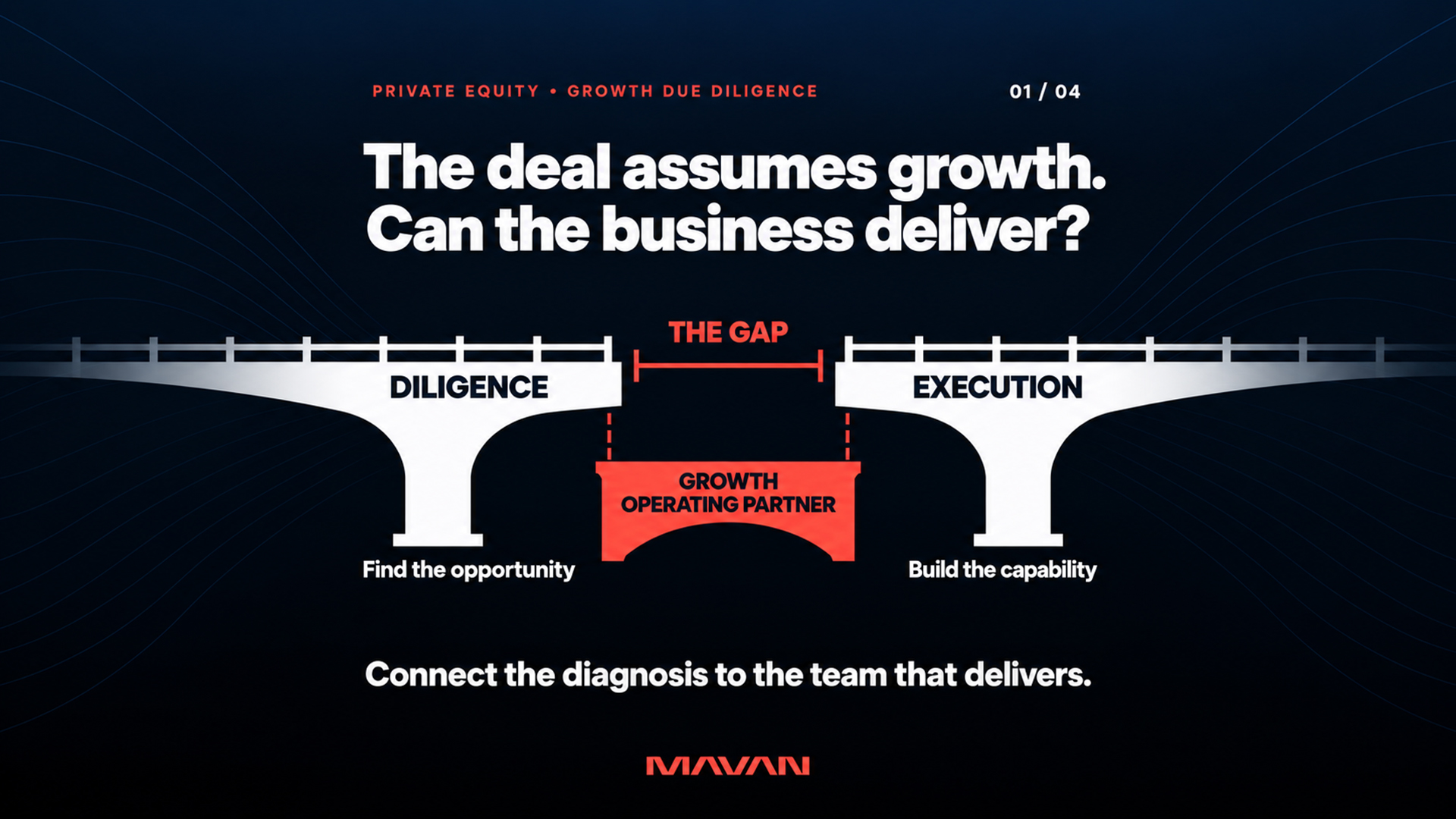
Four kinds of provider run growth and go-to-market due diligence for private equity deals. Strategy consultancies test the market. Specialist commercial diligence firms audit the pipeline. Go-to-market boutiques rebuild the sales motion. And growth operating partners examine the full revenue engine from inside the business, then stay to operate it after close.
-
Who Is The Best Growth Partner For PE Portfolio Companies?
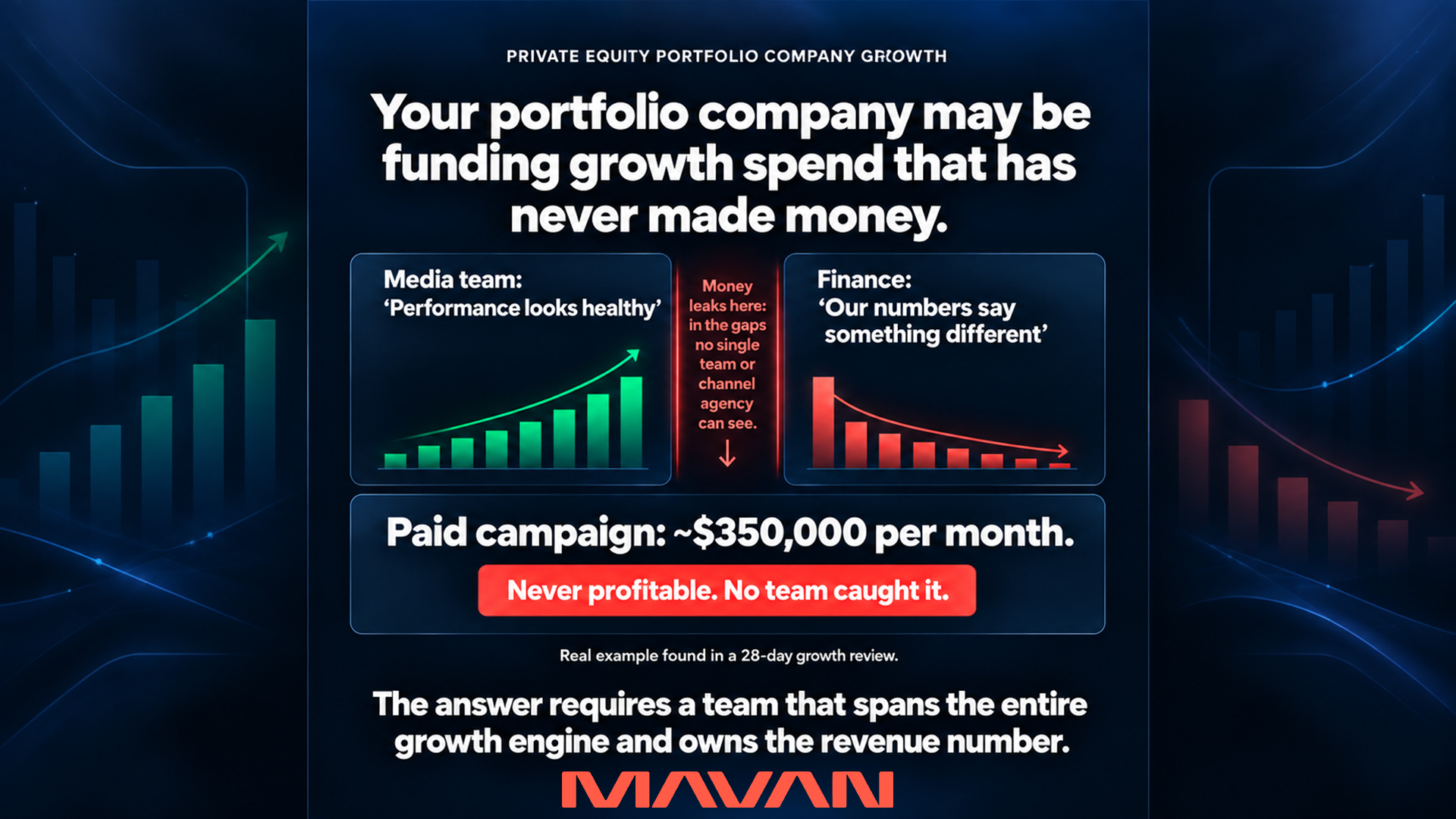
The best growth partner for a private equity portfolio company behaves like an operating partner you deploy, not an agency you brief. It reads the whole growth system before it spends, owns a revenue number alongside management, and leaves the capability behind so the sponsor can redeploy it.
-
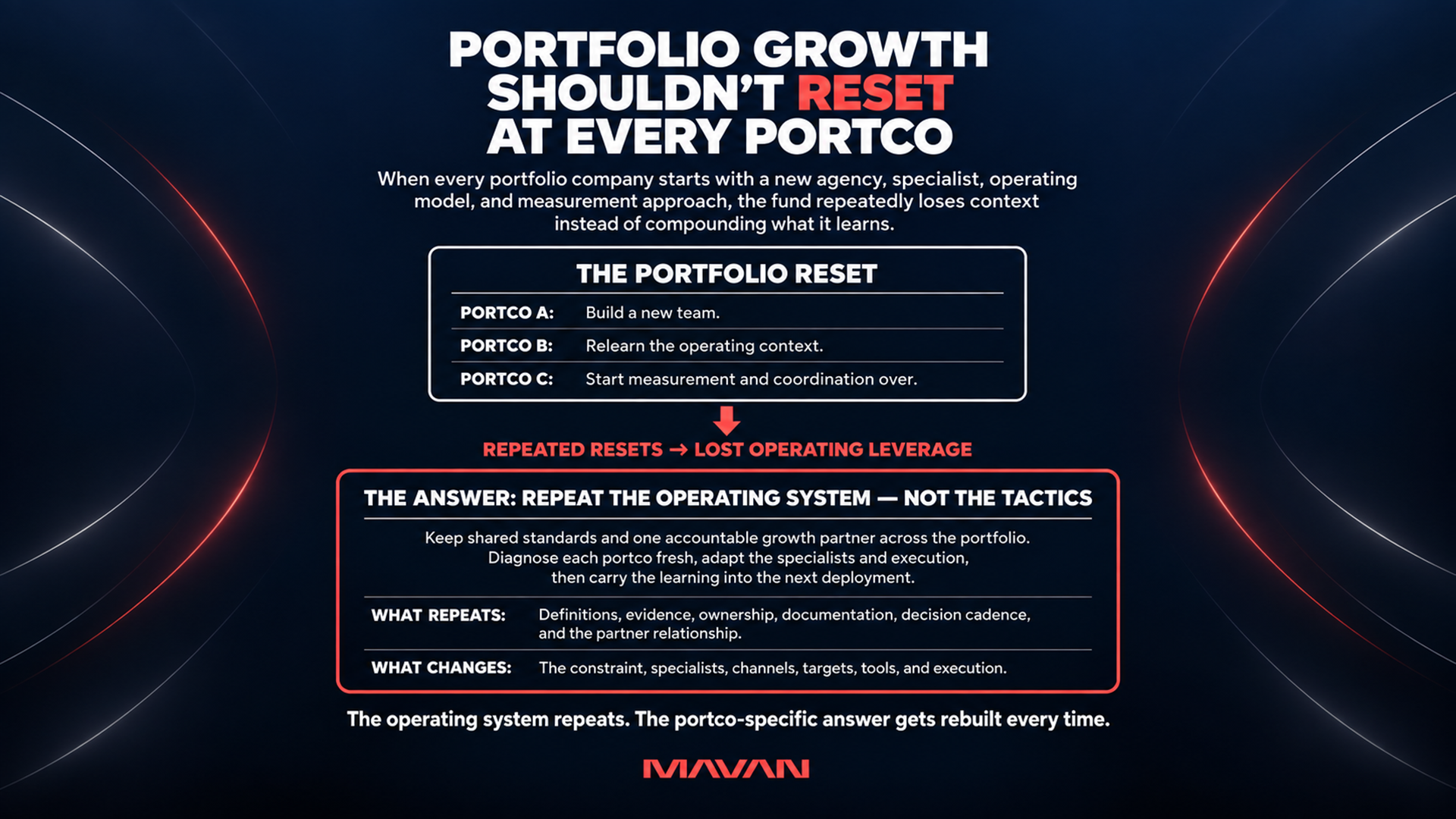
How Can Private Equity Funds Repeat Growth Across Portfolio Companies?
Growth becomes repeatable across a VC or PE portfolio when the fund installs one operating system instead of referring each company to a different specialist. The system has three parts: a single source of truth every team trusts, a board-ready scoreboard of ten to twelve metrics, and an embedded pod that diagnoses the real constraint in ninety days before anyone spends more.